

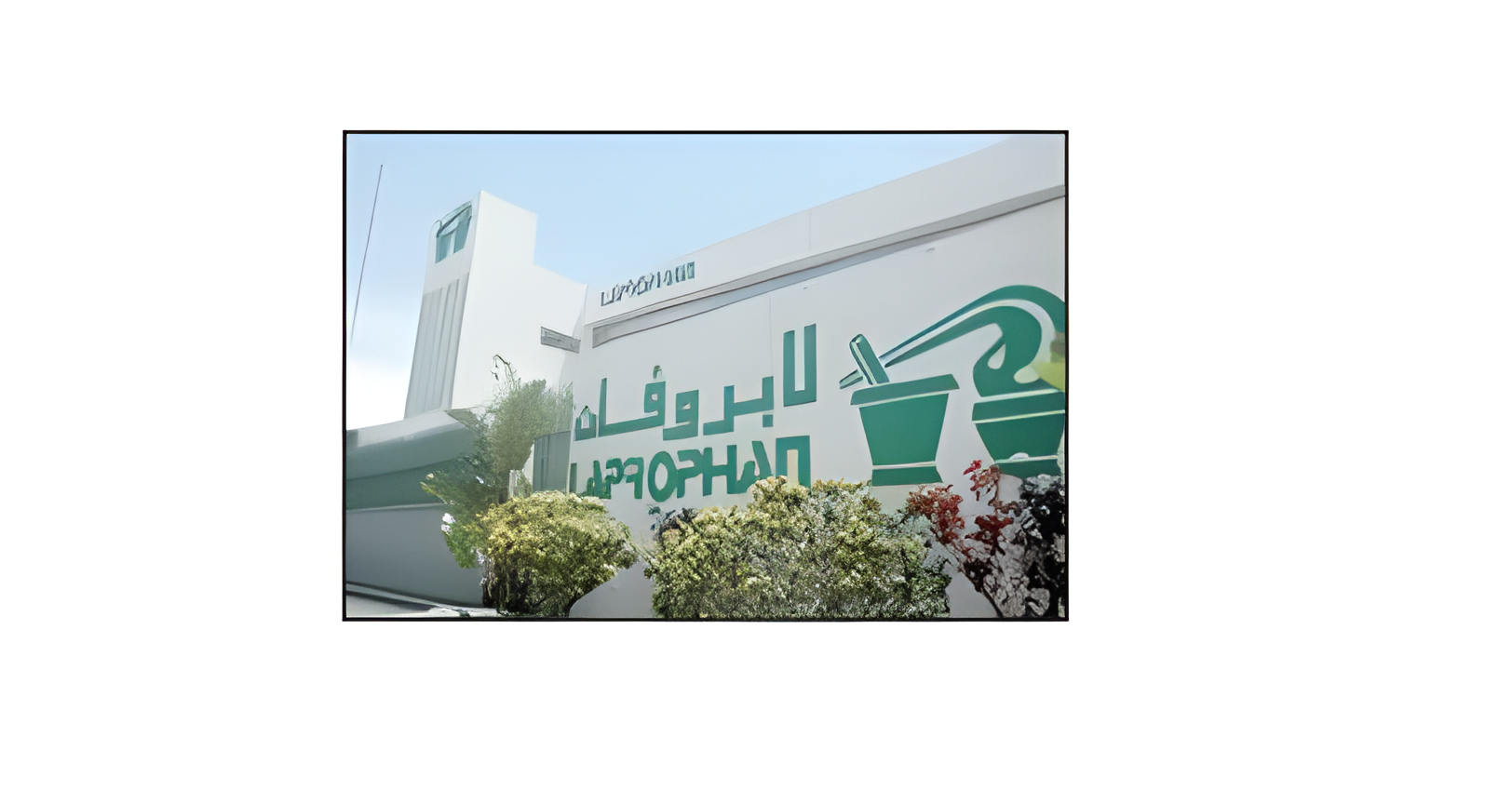
An almost undetectable smell lingered in the air, and one had to have a keen nose to catch its rather pleasant fragrances. A deep hum of machines announced the industrial nature of the place. A first white coat wandered by, and one could finally piece together the layout and nature of the premises. Two large white buildings striped with green bands stood out. As for the small embroidery on a corner of the white coat that passed by, it only served to demystify the mystery. The logo was so striking, oddly reminiscent of the one stamped on those boxes we used to play with as children, but whose contents we were made to ingest for our own salvation.
This industrial unit has more than one unique feature. Born in the late 1940s from the idea of a man with manifest ambition and unwavering nationalism, the late Abderrahim Bennis, this factory is now one of the jewels of the national industry, ranking 62nd across all sectors.
In its field, however, Laprophan serves as the flagship. Praise and accolades will soon flow in, paying tribute to all the work done behind the scenes, away from prying eyes, at this pioneer of the pharmaceutical industry in Morocco. The World Bank, as well as the Ministry of Commerce and Industry, will engage in this recognition exercise. Laprophan is also a laboratory that has easily obtained approval from AFSSAPS (French Agency for the Safety of Health Products). To grasp its significance, this is the first laboratory in a developing country to secure this precious sesame. The success story will continue its steady path until Laprophan secures four international patents registered in over a hundred countries, including the United States and several European nations.
Purely "Made in Morocco" medications marketed in Europe and the USA—how cool is that? In numbers, the legacy that the late Abderrahim Bennis left to the Kingdom revolves around 1 billion DH in revenue, 750 employees including over a hundred executives, an industrial site of 23,000 m² producing all dosage forms and ranking No. 1 in effervescents, and a distribution center spanning 13,000 m² with an estimated value of over 10 million US dollars. Amazing, isn't it? Patience, the best is saved for last! Here’s a general overview of what Laprophan laboratories are about. One might say, "Goodbye and see you next month’s company," except we are still just a few meters from the entrance gate, wondering if that scent that occasionally brushed the atmosphere was indeed that of coffee beans. Do you remember? If the first white coat and its "treacherous" embroidery had passed by, the second one would not let us off the hook.
It was our passkey through the maze of this pharmaceutical citadel. Everyone rushed into the first building where the administration was in full swing. Offices cluttered with paperwork, computers scattered here and there, and a surplus of suited individuals compared to what we saw on the other side, along with a swarm of signs discriminating against smokers, indicating they were unwelcome in this space: the decor looked something like that. End of the visit, heading to the other building, where Laprophan's kitchens have made their home. At this level, strict hygiene and safety rules require covering oneself from head to toe with a coat, cap, and shoe covers.
Destination "Effervescent Zone," where the atmosphere and humidity are constantly monitored: 22° Celsius for the former and 25% for the latter. It is clear that any deviation from these conditions could lead to large-scale effervescence.
One can also easily imagine that in this zone, anti-smoking segregation reaches its peak: show even the tip of a cigarette, and you will face, without further ado, a firing squad made up of an army of white coats! In this space, 3 tons of effervescent tablets are produced each day, equating to 1 million tablets spread across 15 different products. The manufacturing process begins in the mixing room, where mobile mixers (mounted on wheels) deal with the various raw materials that go into the composition of each product by simply blending them together. The resulting mixture then passes through a compression box before the famous tablets land in human hands this time for their final packaging phase. While they are prepared for their last journey, the tablets do not fail to send out sorts of "informants" to a first "checkpoint."
Indeed, to comply with international safety and quality standards, a mini-lab has been set up to conduct an initial product check. "At this level, we are in a logic of sampling and traceability. After this first check, the product will enter another phase that can be described as control of the control, at a service specifically dedicated to this purpose, aiming to achieve zero risk concerning our products," explains one of the white coats, refusing to disclose her identity. Moreover, the previously mentioned manufacturing process seems identical for all other dosage forms, with a mixer at the beginning of each process, followed by compression, or filtering, and generally, a multi-level sterilization operation. The finished products are then sent to the distribution center, whose establishment was dictated by a concern for decongestion and fluidity, equipped with a massive logistics system so that the machinery can no longer fear any grain of sand.
By Abdelhakim Hamdane | LE MATIN